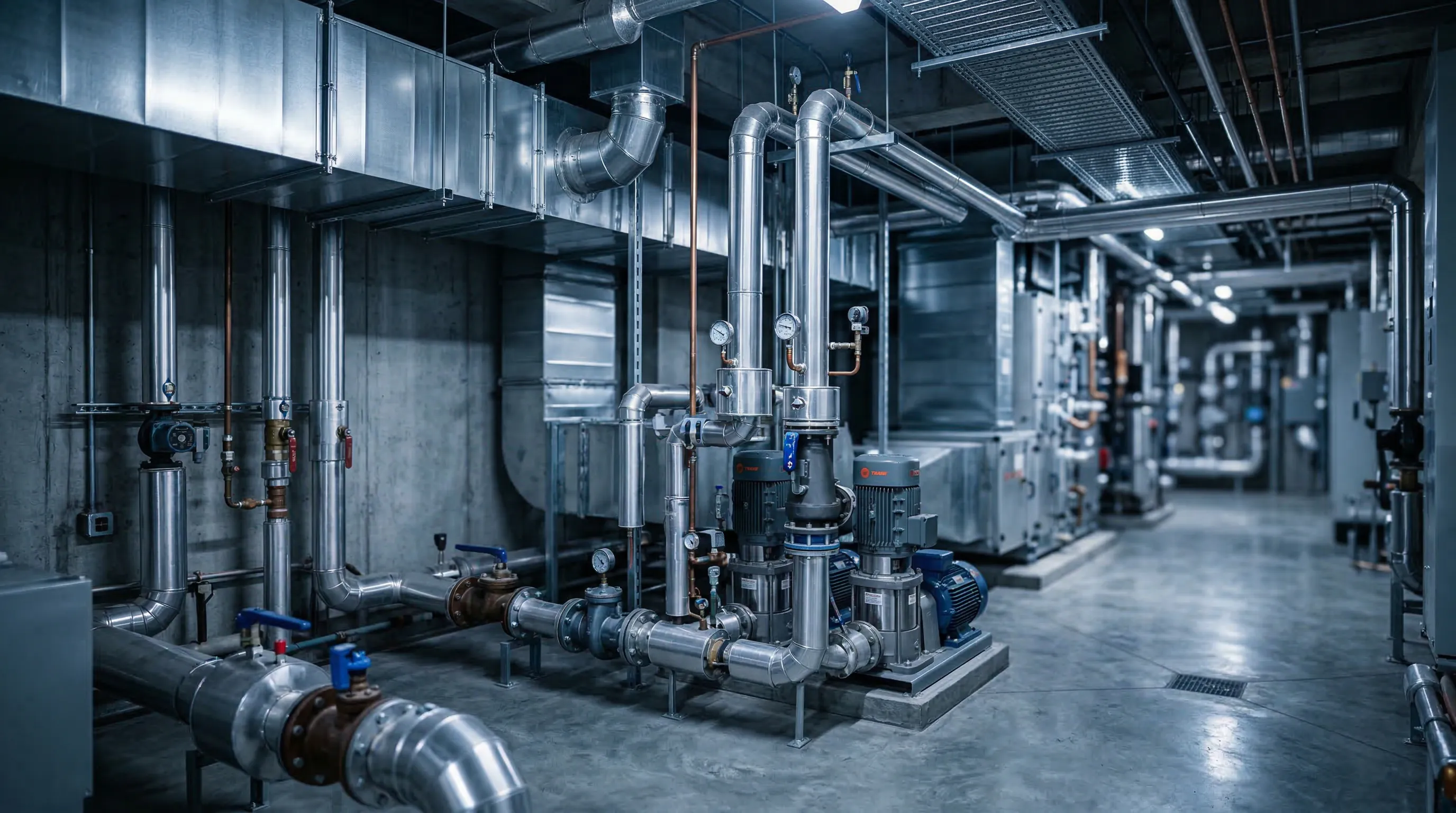
California's 2025 Building Energy Efficiency Standards — Title 24, Part 6 — took effect January 1, 2026. Permits submitted before that date remain under the 2022 code; everything after is subject to the new rules. Here is what actually changed and what it means for your projects.
Heat Pump Mandates: Residential Goes All-In
The most significant residential change: under the 2025 Prescriptive approach, gas space heating is no longer an option for single-family new construction in any climate zone. Heat pump space heating is now the only prescriptive path. A project that wants to use a gas furnace must pursue Performance compliance and clear the new Long-Term System Cost and Source Energy budgets — a path that structurally disadvantages gas.
The 2025 code also tightens how heat pumps are controlled. Supplementary electric resistance heat is locked out when outdoor temperatures exceed 35°F (except during defrost or emergency). Supplementary heat capacity is capped at the heat pump's nominal cooling capacity at 95°F multiplied by 2.7 kW/ton. Defrost delay timers must be set to a minimum of 90 minutes, and thermostats must display outdoor temperature and visually indicate when supplementary or emergency heat is active — with installer certification required on the CF2R.
For domestic hot water, heat pump water heaters (HPWH) are required in all new single-family construction. The 2025 code adds ventilation or minimum room volume requirements for HPWH installations with unconditioned inlet air — a detail with direct implications for mechanical room sizing. The CZ 3, 4, 13, and 14 exception for gas tankless water heaters in homes with heat pump space conditioning has been removed.
Pool and spa heating has also changed: primary heaters must now be heat pump, solar, or at least 60% renewable or recovered energy. This is mandatory, not prescriptive.
Commercial HVAC: New System Baselines for Offices and Schools
On the nonresidential side, the most consequential mechanical change is a new prescriptive system type requirement for office and school buildings under 150,000 SF or five stories, in most climate zones (§140.4(a)3). These projects must now use one of the following:
- VRF heat pump with DOAS and refrigerant loop heat recovery
- 4-pipe fan coil with an air-to-water heat pump (AWHP) and DOAS
- VAV system with AWHP and DOAS
- Dual-fan dual-duct system
- An alternative system approved by the CEC Executive Director
A conventional gas boiler / DX cooling VAV system is no longer a compliant prescriptive choice for these building types. Projects using traditional central plant configurations must go through the performance route.
VRF efficiency requirements in Tables 110.2-F and 110.2-G have been updated with revised EER and SEER2 thresholds. DOAS, heat pump chiller, and heat recovery chiller efficiencies in Tables 110.2-H, I, and J have also increased. Review your equipment schedules against the 2025 tables before finalizing selections.
ASHRAE Guideline 36 Is Now Prescriptive
ASHRAE Guideline 36 ("High-Performance Sequences of Operation for HVAC Systems") has been formally incorporated into the prescriptive requirements under §140.4, covering VAV systems, economizer controls, supply air temperature reset, and DDC controller logic. DDC programming libraries must now be certified against Guideline 36 via Reference Joint Appendix JA18.
Confirm early whether your controls vendor has a CEC-certified library. Projects using uncertified libraries must demonstrate compliance through the performance pathway. New acceptance testing requirements under §120.5(a) cover DOAS, HRV, and ERV systems, as well as cooling tower conductivity controls and overflow alarms.
Heat Recovery and Cooling Tower Requirements
New mandatory heat recovery requirements under §140.4(s) apply to buildings meeting either of these thresholds:
- Peak cooling load ≥ 200 tons, with equipment power density > 5 W/sf and minimum OA < 0.5 cfm/sf, and service water heating plus space heating ≥ 2,200 kBtuh
- Cooling design capacity ≥ 300 tons and service water heating ≥ 700 kBtuh
These thresholds target large commercial, institutional, and tech campus projects. Heat recovery needs to be integrated at the plant design level — not added late in the process.
Cooling tower requirements have also been updated: cycles-of-concentration parameters revised under §110.2(e), and a new Table 140.4-H-2 establishes prescriptive minimum fan efficiencies for open-circuit towers at or above 900 GPM.
Pipe Insulation and Laboratory Exhaust
The 2025 code extends mandatory pipe insulation requirements to process heating and cooling systems under §120.3(a). Previously, process piping was largely outside Title 24's scope. Insulation values must now comply with Tables 120.3-A-1 and 120.3-A-2, with a new calculation method in §120.3(c) for materials outside the tabulated conductivity ranges.
Laboratory exhaust systems under §140.9(c) are now subject to prescriptive energy code requirements for the first time. Healthcare facilities are exempted. Lab designers who relied on a code exemption for lab exhaust need to account for this in their compliance documentation going forward.
Performance Compliance: TDV Out, LSC and Source Energy In
The 2025 code replaces Time Dependent Valuation (TDV) with two new performance metrics. Long-Term System Cost (LSC) is split into Efficiency LSC (space conditioning, water heating, ventilation, and lighting) and Total LSC (Efficiency LSC plus contributions from PV, battery storage, and demand flexibility). Source Energy runs a parallel budget using the same end uses. All three scores — Efficiency, Total, and Source — must pass for the project to comply.
This is a meaningful methodological change. Projects that cleared TDV budgets primarily through PV offsets will need to verify performance under the new framework. For nonresidential performance compliance, IESVE has been approved by the CEC for the 2025 code cycle — its fifth consecutive approval. The software supports the updated LSC and Source Energy methodology with automated NRCC form generation, and its three-model workflow (Actual, Proposed, and Standard Design) integrates naturally with the new on-site generation credit structure.
Documentation: HERS Is Now ECC
The HERS Program has been renamed the Energy Code Compliance (ECC) Program. HERS Raters are now ECC-Raters; HERS Providers are now ECC-Providers. Field verification and diagnostic testing procedures continue without interruption, but all certifications and registry entries reflect the new terminology. Fault indicator display (FID) requirements have been added for HRV and ERV systems, with ECC-Rater field verification required.
Practical Takeaways for Architects and Building Owners
Budget for heat pump systems from day one. There is no prescriptive path around heat pump space heating in new single-family construction, and commercial offices and schools in most climate zones now have a heat pump-based system as their prescriptive baseline.
Plan equipment rooms for HPWH requirements. Ventilation or minimum room volume for HPWHs must be resolved in schematic design, not at permit.
Flag large cooling loads early. Buildings approaching 200–300 tons of cooling need heat recovery analysis in SD. The mandatory thresholds in §140.4(s) apply regardless of system type.
Confirm controls vendor Guideline 36 certification. Uncertified libraries push ASHRAE Guideline 36 compliance to the performance pathway, which adds modeling scope. Resolve this early.
Use approved energy modeling software. The LSC and Source Energy methodology is a departure from TDV. IESVE and other CEC-approved tools have been updated for 2025; using a validated platform eliminates calculation risk on live permit submissions.
The 2025 code continues California's electrification trajectory with more specificity than previous cycles. The prescriptive heat pump requirements, the Guideline 36 controls mandate, and the new performance metrics all require earlier coordination between the design team, controls vendors, and energy modelers. Start those conversations at project kickoff — not when the permit package is due.